
The first foreign trip of the renewed mandate has its number, and the number is US$2.14 billion. That is the combined value of the memoranda of understanding signed in President Hakainde Hichilema's presence at the Zambia-UAE Business Forum in Abu Dhabi on Tuesday, the centrepiece of a two-day working visit that ends today — a visit the foreign ministry billed from the start as work, not ceremony, and that has now produced the paperwork to prove it.
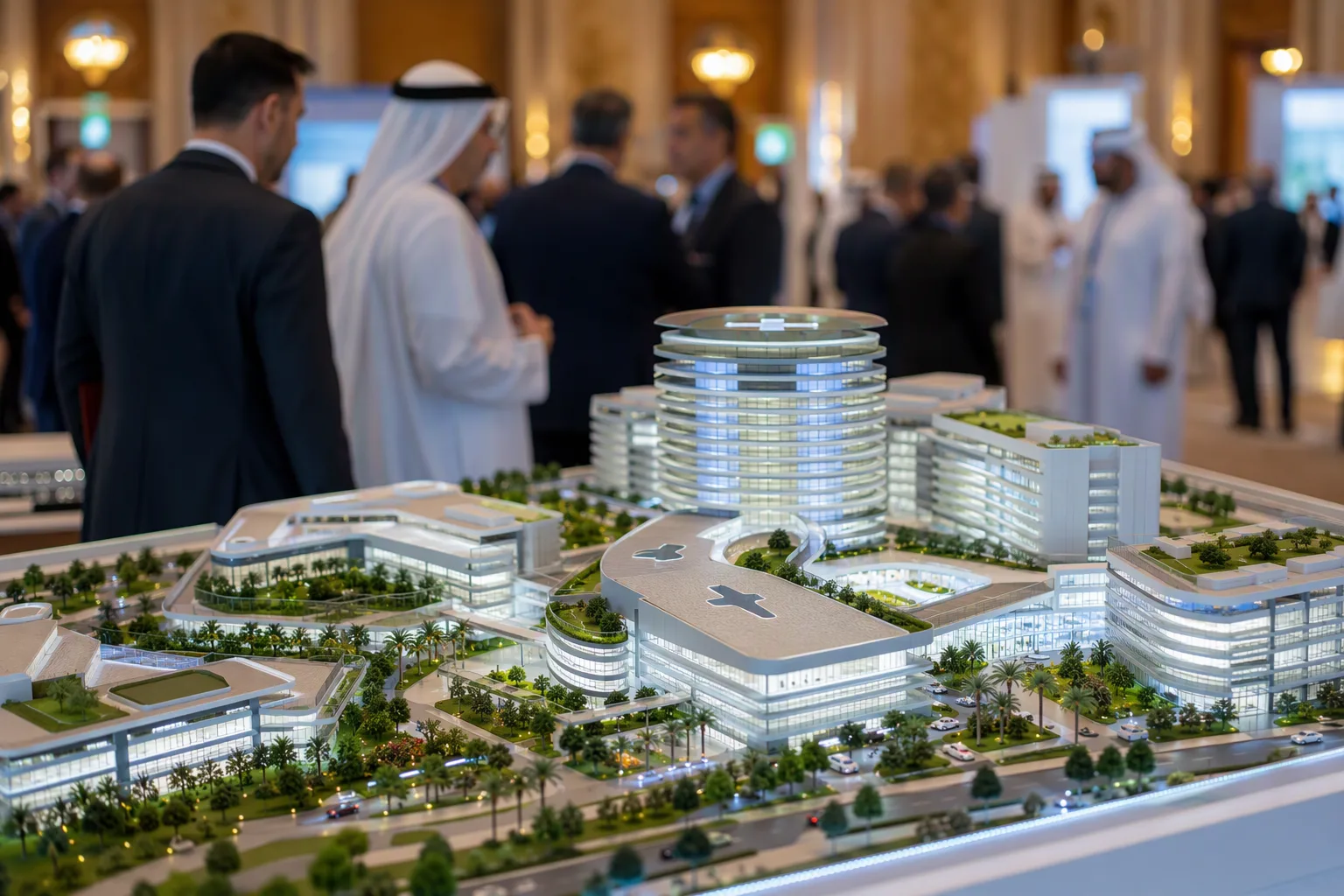
The anchor is health. The Ministry of Health signed a US$2 billion memorandum with DIHAD Sustainable Project Management LLC of Abu Dhabi to develop what the government calls a Medical City in Lusaka — a project Health Minister Professor Roma Chilengi says will position Zambia as southern Africa's health-tourism hub, the first facility of its kind in the region. The ministry's announcement says the arrangement will also open a corridor the other way: DIHAD is to help Zambian patients access treatment in the UAE through competitively priced packages. The ruling party's own channels were calling it the "MEDCO MoU" by Tuesday evening; the document signed is a memorandum of understanding — a statement of intent, not a construction contract — and neither a site, a timeline nor a financing structure has been disclosed.
The forum's other signatures span mining and mineral value addition, agriculture, energy, infrastructure, transport and logistics, tourism and the digital economy — the Grow Zambia Agenda's full shopping list. The President gave the room a number to take home: Zambia's target of three million tonnes of copper a year will require about 8,000 megawatts of electricity, he said, for copper alone, and he offered the Emirates' patient capital the instruments it understands — energy reforms open to independent producers and traders, and power purchase agreements of 20 to 25 years. The UAE's Undersecretary for Foreign Trade, Fahad Siddiq Al Gergawi, told the forum his country sees clear room to deepen cooperation in agriculture, energy, healthcare and the digital economy.
The sharpest exchange of the trip happened away from the podium. In talks with Ali AlRashdi, chief executive of International Resources Holding — the Abu Dhabi firm that has invested more than US$1.1 billion in Mopani Copper Mines since taking a 51 per cent stake in 2024 — the President challenged Mopani to unlock more copper from its tenements, step up exploration and carry its share of the three-million-tonne-by-2031 national target. AlRashdi, whose company has reported a strong production turnaround at Mopani, said the miner remains committed to the target. It was, in effect, a head-of-state performance review of the country's flagship Gulf investment — delivered in the investor's home city.
Two pieces of context belong in any honest account of the day. The first is a rebuttal: claims circulated on social media that the President had flown into a country in mourning. A ten-day mourning period was indeed declared — in Dubai, for Sheikh Ahmed bin Rashid Al Maktoum, the Dubai ruler's youngest brother. The President's engagements are in Abu Dhabi, a separate emirate and the federal capital, where the forum proceeded with senior UAE officials present. The second is a question the visit cannot dodge: UAE trade records show far higher imports from Zambia than Zambia records as exports to the UAE, and gold accounts for most of the difference. Trade analysts caution that such gaps often arise from how origin and destination are recorded and are not, in themselves, proof of wrongdoing — but the government is already moving on the gold question, with ZCCM-IH working to bring small-scale gold into formal channels and a cut to the 16 per cent VAT on gold transactions under consideration. A deeper UAE relationship is precisely where those records get reconciled.
What did not happen on Tuesday matters as much as what did. The Comprehensive Economic Partnership Agreement — the trade pact both governments say they want — remains unsigned; the President said Zambia looks forward to it. The bilateral meeting with UAE President Sheikh Mohamed bin Zayed Al Nahyan, who issued the invitation, anchors the visit's second day. And every memorandum now enters the corridor where Zambian headline deals go to be tested: implementation. The President himself framed the standard on departure — the focus, he said, is investment and private sector-led growth. By tonight the visit ends. By the next budget, the country will know how much of Tuesday was paper and how much was pipeline.
Signed vs. promised
Signed: MoUs worth a combined US$2.14 billion at the Zambia-UAE Business Forum (29 September), including the Ministry of Health–DIHAD memorandum valued at US$2 billion for a Medical City in Lusaka; the signings were witnessed by President Hichilema and confirmed by State House.
Promised / pending: The Comprehensive Economic Partnership Agreement (both sides say they are working toward it; not signed); the Medical City's site, timeline and financing (not disclosed — an MoU is not a construction contract); Mopani's expanded output (a presidential challenge and a company commitment, not a production figure); the CEPA-era trade and gold-recording reforms (under way or under consideration).
Sources: Lusaka Times, "HH seals US$2.14 billion in pledges as Abu Dhabi opens its doors to Zambia" (29 Sep 2026); State House, "Zambia, UAE seal $2.1bn deals" (29 Sep 2026); Ministry of Health announcement via Prof. Roma Chilengi (29 Sep 2026); Diamond TV, "Zambia signs US$2.14 billion MoUs with UAE" (29 Sep 2026); ZNBC, "HH challenges Mopani Copper Mines to ramp up copper production" (29 Sep 2026); Efficacy News (29 Sep 2026); Zambian Observer (29 Sep 2026); Times of Zambia on the visit itinerary (28 Sep 2026); Zawya/IRH on Mopani investment figures (Jul 2025).
Back to the front page