
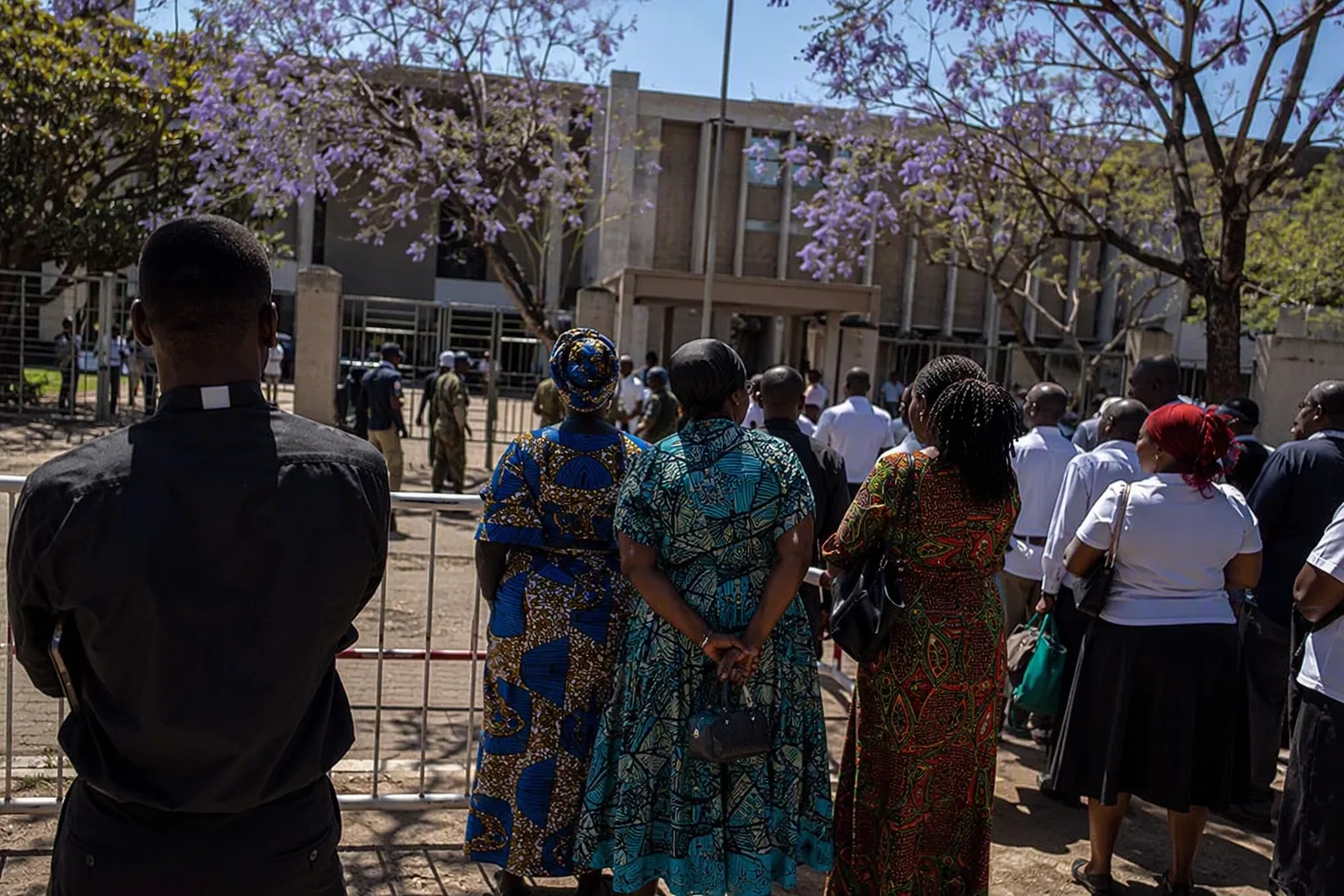
They heard Mass for him at eight. By midday the State had charged him, and by afternoon the most senior Catholic in the country was standing in a magistrate's court hearing the conditions of his own bail. Monday's sequence was swift, deliberate and without precedent in living memory: the Most Reverend Dr Alick Banda, Archbishop of Lusaka, is now a criminal defendant awaiting trial.
The charge, read to him after he presented himself at the Drug Enforcement Commission at 10:00 as summonsed, is possession of property reasonably believed to have been unlawfully obtained, contrary to Section 319 of the Penal Code. The property is by now familiar: a blue Toyota Hilux, registration ALF 7734, which the commission says the Archbishop possessed between 22 April 2021 and 27 December 2023 and which it suspects was unlawfully obtained from the Zambia Revenue Authority — one of about 22 ZRA vehicles whose irregular disposal has already sent the tax authority's former commissioner general and his director of administration to prison. DEC spokesperson Allan Tamba announced the formal charge and arrest in a statement on Monday afternoon, urging the public to avoid inflammatory statements and affirming that the commission discharges its mandate through "lawful and evidence-based processes".
From the commission's headquarters the Archbishop was taken to the Lusaka Magistrates' Court, where the matter came before Magistrate Mwandu S. Nakazwe. He pleaded not guilty. Bail was granted in his own recognisance of K80,000, with three sureties bonded at K50,000 each — required, the court stipulated, to be Lusaka residents employed by reputable organisations. He was ordered to surrender all travel documents. The case was adjourned to 14 October for mention, with trial scheduled to commence on 3 November. The Director of Public Prosecutions, Gilbert Phiri, was seen at the court, a measure of how seriously the State is taking a case it insists is about a vehicle, and nothing more.
The Church's day was built around him. The Archdiocese of Lusaka had called Catholics to the 08:00 solidarity Mass at the Cathedral of the Child Jesus, asking them to pray for his safety, wisdom and well-being; the Zambia Conference of Catholic Bishops issued its own statement on Monday, saying the Archbishop was entitled to fairness, dignity and due process and calling for the process to be handled "without prejudice or intimidation". Police, who had warned on Sunday against processions and unlawful assemblies, kept the day's choreography tight: only lawyers and persons connected to the matter were allowed to accompany him. There was no repeat of January's several-thousand-strong march. There was, instead, a courtroom.
As this edition went to press on Tuesday morning, one thread remained unresolved. Although bail was granted on Monday afternoon, allies of the Archbishop — among them former ambassador Emmanuel Mwamba — said he remained in custody overnight while the sureties and bail formalities were being processed. Images circulated on social media appearing to show a white van leaving the court precincts. The Archdiocese had not issued a statement on his status by press time, and the DEC declined to say more than that the public would be updated "as and when it will be lawful to do so". Whether the Archbishop slept at home or in a cell is, by this morning, a fact the authorities owe the public quickly — not least because the Church that prayed for him at eight o'clock yesterday is watching, and praying again.
What Monday changed is the arena. For nine months this affair lived in summonses, statements and processions — in the court of public standing, where both sides are fluent. It now lives in a magistrate's court, where fluency is irrelevant and evidence is everything. The State has until 3 November to assemble a case that proves more than possession. The Archbishop has the same weeks to prepare an answer he declined to give investigators in January. And the country, which spent Monday watching a Mass and a motorcade, has a date with the question underneath both: whether Zambia's institutions are prosecuting a vehicle, or a voice.
Confirmed vs. alleged
Confirmed: The DEC formally charged and arrested Archbishop Banda on Monday 28 September under Section 319 of the Penal Code over a blue Toyota Hilux, ALF 7734, suspected to have been unlawfully obtained from the ZRA; he appeared before the Lusaka Magistrates' Court and pleaded not guilty; bail was set at K80,000 in his own recognisance with three sureties of K50,000 each, and he was ordered to surrender his travel documents; the matter was adjourned to 14 October for mention with trial scheduled for 3 November; the ZCCB issued a solidarity statement; the DEC urged the public to avoid inflammatory statements.
Alleged / unsubstantiated: That the Archbishop remained in custody overnight despite the grant of bail (stated by allies including Emmanuel Mwamba on Tuesday morning; not confirmed by the court, the DEC or the Archdiocese at press time); that the prosecution is political persecution (the bishops' and opposition's characterisation, rejected by the government, the UPND and the DEC); that the Archbishop knew the vehicle was unlawfully obtained (untested; he has pleaded not guilty).
Sources: Mwebantu, "DEC charges and arrests Archbishop Alick Banda over ZRA vehicle" (28 Sep 2026); Zambian Eye, "Archbishop Banda pleads not guilty, granted K80,000 bail after DEC arrest" (28 Sep 2026); Mwebantu, "Court grants Archbishop Alick Banda K80,000 bail" (28 Sep 2026); Times of Zambia (28 Sep 2026); eNCA, "Zambia arrests archbishop and government critic" (28 Sep 2026); ZNBC (29 Sep 2026); Emmanuel Mwamba on Facebook (29 Sep 2026); Lusaka Brief reporting on the January warn-and-caution (28 Sep 2026).
Back to the front page