
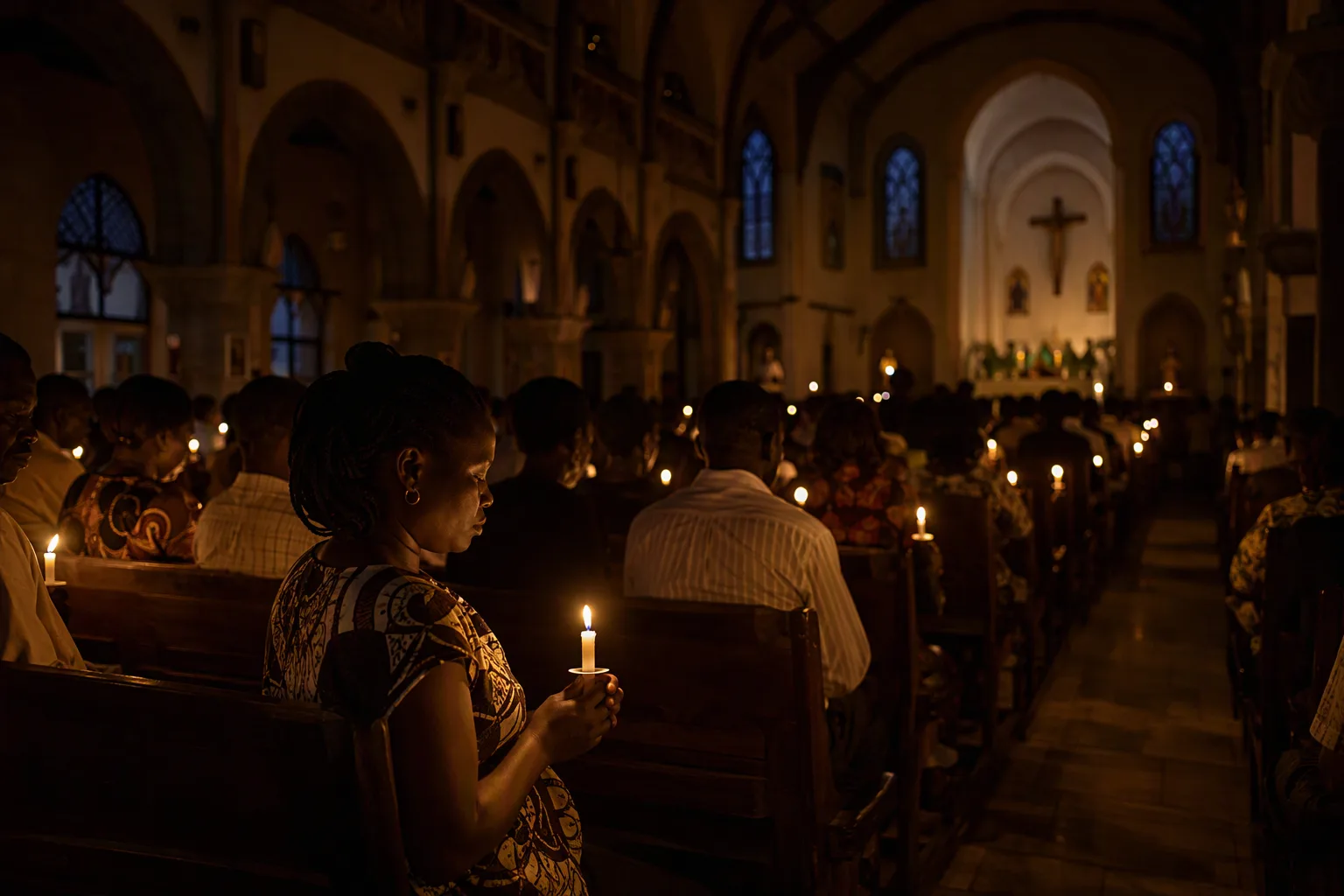
The reactions sorted themselves, as they always do in this country, into three registers — the liturgical, the political and the procedural. By Monday evening all three were in circulation, and none conceded an inch to the others.
The Church kept to its register. The Zambia Conference of Catholic Bishops' statement on Monday was notable for what it did not say: no talk of persecution this time, none of the fire of January's "state-sponsored persecution" charge. Instead the bishops asked that the process be conducted without prejudice or intimidation, and affirmed that their brother was entitled to fairness, dignity and due process. It is the language of a Church that has decided the courtroom, not the communique, is where this is now fought — while reserving every right to return to the communique. The Archdiocese's own prayer intentions, read at the morning Mass, asked for the Archbishop's safety and for "truth, justice and peace" in the process.
The opposition kept to its register too. A post on Brian Mundubile's official page condemned "the UPND government over the summoning and planned arrest" of the Archbishop — a message folded into the alliance's standing narrative of a state turned against its critics. That narrative now has its most photogenic member: a metropolitan archbishop in a magistrate's court carries a symbolism no rally can buy. It also has an international audience — the arrest was covered within hours by eNCA in Johannesburg, framed as the latest in a string of arrests of government critics, a framing Lusaka will find harder to wave away than a Facebook post.
And the State kept to its register. The DEC's statements were procedural to the point of repetition: the investigation arises from a warn-and-caution recorded on 5 January; the vehicle is one of roughly 22 improperly disposed ZRA assets; the commission acts on evidence, not offices; citizens should refrain from inflammatory statements. The commission's director-general, Nason Banda, made the point personally in January — he is a practising Catholic, he said, and the Archbishop is his archbishop; the call-out went to a name in a case record. The government and the ruling party have held the same line since: institutions, not individuals, are doing this work.
The fourth voice belongs to civil society, and it is the least comfortable for the Archbishop's own camp. Activist Laura Miti asked last year, when the ZRA convictions landed, what the Archbishop thought was a good reason to be gifted a public institution's vehicle at all — "what was he told was the reason he had been selected to receive an asset from a public institution he had no relationship with?" It is a question that survives Monday's sympathy. Solidarity with a shepherd is one thing; the Hilux is another, and 3 November will ask about the Hilux.
There is a quiet irony the day leaves behind. Both sides have spent months insisting they want the same thing — a lawful process, transparently conducted. On Monday they got one: a summons answered, a charge read, a plea entered, bail granted, dates set. The machinery worked, in public, on the biggest name it has touched. What each side says about that machinery next will depend, as ever, on what it does next.
Sources: Zambian Eye on the ZCCB statement (28 Sep 2026); Brian Mundubile's official page, via Smart Eagles (Sep 2026); eNCA (28 Sep 2026); DEC statements (27–28 Sep 2026); Lusaka Times, "Laura Miti on Archbishop Banda's ZRA Vehicle Gift" (Oct 2025); ACI Africa and CISA on the January ZCCB position (Jan 2026).
Back to the front page