
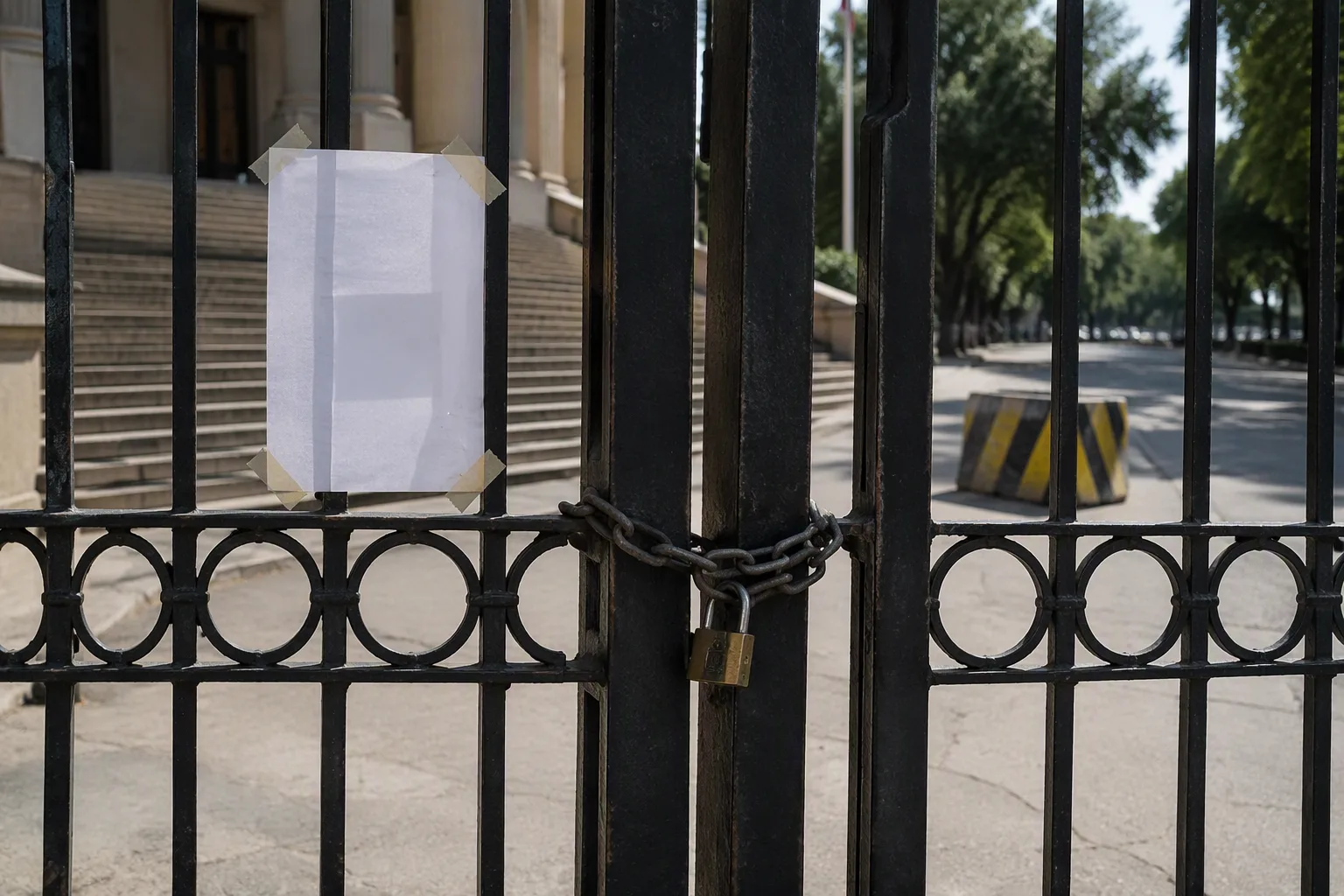
For six weeks, the question of who closed Zambia's courts in August had no official answer. It has one now — and the answer is not the Judiciary. In submissions before the Constitutional Court, Attorney-General Mulilo Kabesha has stated that the three-day shutdown from 24 to 26 August was ordered by the country's defence and national security services, and that the Judiciary's Chief Administrator merely communicated their directives to staff and the public. It is the first time the State has formally placed responsibility for one of the post-election period's most contested episodes — and it places it on the security establishment.
The episode itself is not in dispute. The closure began on 24 August — the final day under Article 105 of the Constitution for lodging a challenge to the presidential election result. The High Courts in Lusaka, Ndola, Chipata and Livingstone, the Constitutional Court and the Supreme Court were shut, along with some Local Courts; a judiciary memo cited security concerns and instructed staff not to report for work, while police restricted access to court premises. The Africa Judges and Jurists Forum voiced concern within hours. Chapter One Foundation then petitioned the Constitutional Court, arguing the closure and the restrictions on access violated Articles 118, 119 and 122 — judicial authority, access to justice and the independence of the Judiciary. It wants the closure declared unconstitutional, unlawful and null and void; it wants the State compelled to disclose the nature of the security concerns and the legal authority relied upon; and it wants the names of those who authorised or carried out the closure made public.
The Attorney-General's response, filed this week, defends the shutdown on its merits while denying the Judiciary made it. National security matters, he submits, fall to the Defence Force and National Security Services under Part XV of the Constitution; the decision to close court precincts was prompted by security concerns; and the Constitution imposes no absolute duty to keep every courthouse physically open during an assessed threat. "The precautionary measures pursued legitimate public safety objectives, protecting human life, court users and public officers, and were lifted once the threat de-escalated, also affecting institutions like the Ministry of Justice and the National Prosecution Authority," he argues. He adds that the petitioner has cited no provision obliging security agencies to disclose the full details of threats against a person, State organ or institution — a direct answer to the demand for the threat's nature and the decision-makers' names.
Alongside the merits, the State wants the case ended at the door. The Attorney-General raises preliminary objections under Article 128(3) of the Constitution and the Constitutional Court Rules 2026, arguing the petition does not meet the requirements for the court to hear it — a mismatch, he says, between the constitutional provisions relied on and the administrative steps being challenged — and asks that it be dismissed with costs. The Foundation's case thus faces the oldest judicial fork: thrown out on the objection, or heard on the substance.
Whichever way the court turns, the admission stands. On the State's own account, the decision that emptied the courts on the last day for a presidential petition was made outside the Judiciary and relayed through it — the arrangement the Constitution's separation-of-powers articles were written to prevent, or the prudent deference of a judiciary to a genuine security assessment. That is now the question the Constitutional Court must approach, in a petition about its own closure, brought by a foundation that wants to know, above all, whose hand was on the gate.
Confirmed vs. contested
Confirmed: Courts were closed 24–26 August 2026 and police restricted access; the closure began on the Article 105 deadline day; the Attorney-General has submitted that security agencies ordered the closure and the Judiciary's Chief Administrator communicated it; the State seeks dismissal with costs on preliminary objections; Chapter One Foundation seeks declarations, disclosure of the security concerns and the identities of those who authorised the closure.
Contested / unproven: The nature and severity of the security threat (not disclosed; the State says no disclosure is required); whether the closure was a proportionate precaution or an unconstitutional obstruction of the presidential-petition window — the very question the court has yet to hear.
Sources: Lusaka Times, "Who Shut the Courts? State Points to Security Services" (30 Sep 2026); Attorney-General's submissions in the Chapter One Foundation petition (Sep 2026); Africa Judges and Jurists Forum statement (24 Aug 2026); Lusaka Brief archive on the post-election period (Aug–Sep 2026).
Back to the front page