
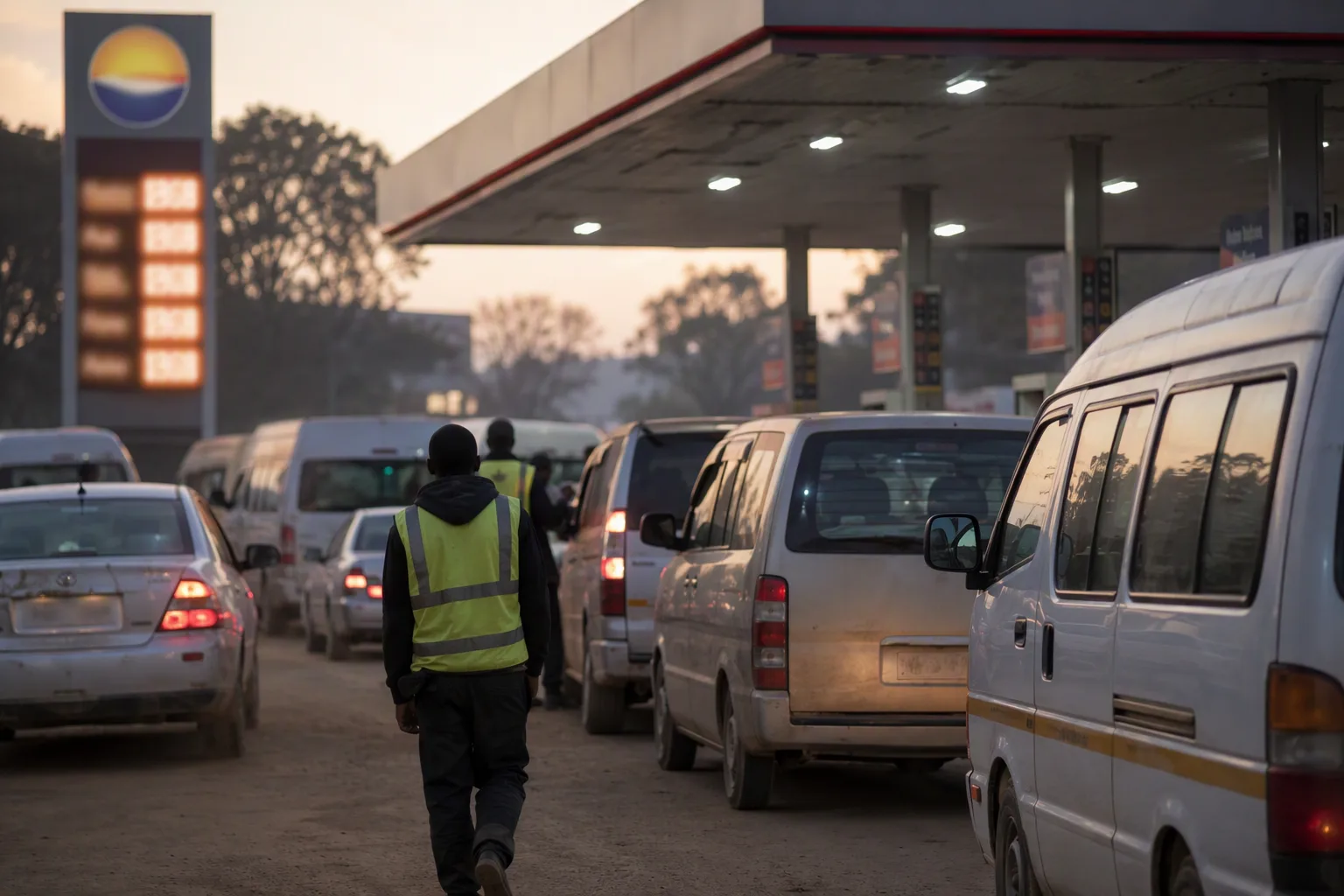
Midnight came, the government printer stayed silent, and the dashes became numbers again. Statutory Instruments No. 56 and No. 61 of 2026 — the excise-duty suspension and VAT zero-rating that have cushioned the pump since April — expired as Wednesday turned to Thursday, exactly as this newspaper warned they might. The Energy Regulation Board had published its answer hours earlier: from midnight, the national uniform pump price of petrol rises from K25.29 to K31.46 per litre, diesel from K26.86 to K33.27, kerosene from K27.02 to K29.76 and Jet A-1 from K28.71 to K31.85. Petrol and diesel are both up by almost a quarter in a single review — the steepest adjustment since the waiver era began.
The Board's statement, issued on Wednesday, lays out the three forces in the build-up. International prices rose across the review period on sustained geopolitical tension in the Middle East: the average price of petrol moved from US$104.94 to US$121.58 a barrel, diesel from US$150.92 to US$160.88, and kerosene/Jet A-1 from US$125.30 to US$144.00. The kwacha, the one variable that had been pulling for the consumer all year, turned: it depreciated from K19.28 to K19.76 to the dollar. And on top of both came the policy decision — the government's resolution to reinstate excise duty with effect from October. "The combined effect of higher international petroleum prices, depreciation of the exchange rate and the reinstatement of excise duty has necessitated an upward adjustment in domestic petroleum prices," the Board said, adding that the determination was necessary to safeguard security of supply.
The detail the headline hides is the split decision. Excise is back tonight; VAT is not. The zero-rating of value-added tax stays in place until 1 December, when it too is scheduled to be reinstated. October's jump, in other words, is the market plus the smaller of the two tax lines — December's review is when the bigger one lands, unless the Treasury blinks again. The July precedent says eleventh-hour extensions happen; the Green Paper published at the weekend, committing the government to broadening the tax base and rationalising exemptions, says this one is being allowed to run.
Where the consumer lands is measurable. Diesel at K33.27 is within seventy-two ngwee of May's all-time peak of K33.99, reached at the height of the Middle East supply shock. Petrol at K31.46 is back above thirty kwacha for the first time since last year. The ERB noted that its price-smoothing mechanism, working with the tax relief, had kept Zambian pump prices among the lowest in the SADC and COMESA regions — at K26.86, September's diesel was roughly a fifth below South Africa's inland benchmark. October tests that boast: the smoothing mechanism now carries the full load it has never carried alone.
The timing carries its own irony. On the same Wednesday, the Bank of Zambia cut its policy rate by 250 basis points — the biggest cut in more than a decade — on the strength of an inflation rate it has helped wrestle back inside the target band, a containment the central bank's own analysis credits in part to the fuel-tax relief. One institution spent Wednesday counting the benefits of the waiver; another spent it withdrawing the waiver. And in Abu Dhabi, on the second day of his working visit, President Hichilema was discussing the same problem from the supply side with Ahmed Bin Thalith, chief executive of ADNOC Global Trading — long-term supply arrangements, and an escape from the monthly price roulette itself. "While we cannot control some of the factors that drive fuel prices, such as global conflicts that disrupt international oil supply chains, we can make our pricing mechanism more predictable and business-friendly," the President said. Predictability, as of this morning, costs K31.46 a litre.
What moves next is not the price board but the economy around it: commuter fares on the minibus routes, the maize-meal chain, the transport line in next month's inflation print, and the arithmetic of the IMF mission sitting in Lusaka this week reading a budget framework that just got its fuel subsidy question answered. The waiver is over. The argument about what replaces it — an ADNOC arrangement, a narrower targeted relief, or nothing at all — starts today.
Confirmed vs. unknown
Confirmed: The October review takes effect at midnight on 30 September — petrol K31.46, diesel K33.27, kerosene K29.76, Jet A-1 K31.85; the ERB cites higher international prices, a kwacha at K19.76/US$ (from K19.28) and the reinstatement of excise duty from October; VAT zero-rating remains until its scheduled reinstatement on 1 December 2026; the government had said as of 26 September that no extension decision had been taken, and none was gazetted.
Unknown at press time: How quickly transporters and retailers reprice; whether the VAT reinstatement proceeds on 1 December or is extended; the shape and terms of any long-term fuel-supply arrangement with ADNOC, and whether it would change the monthly review mechanism.
Sources: ERB October 2026 pump-price statement and price build-ups, via Mwebantu, "ERB hikes fuel prices for October as tax relief ends, Kwacha weakens" (30 Sep 2026); ERB current prices, erb.org.zm (1 Oct 2026); Radio Phoenix, "Govt yet to decide on extension of fuel tax waivers" (26 Sep 2026); Times of Zambia, "President Hichilema holds UAE talks on digitalisation, fuel price stability" (30 Sep 2026); Bank of Zambia MPC statement (30 Sep 2026); Kweli corridor analysis of the ERB build-ups (Sep 2026).
Back to the front page