
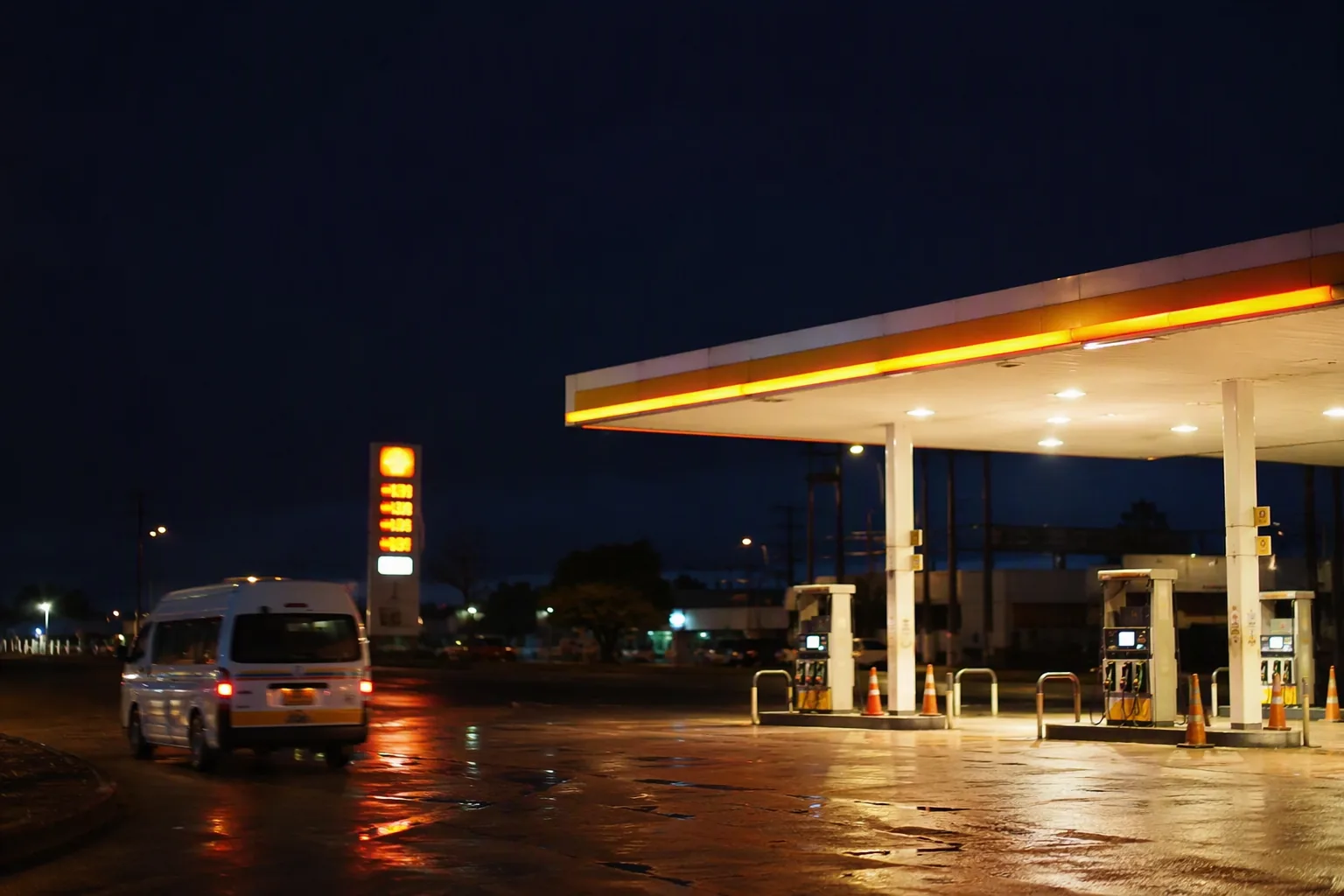
It is the last full day of the cheapest diesel in the region, and nobody in authority will say whether it stays that way. The temporary suspension of excise duty and the zero-rating of VAT on petrol and diesel — the two tax lines that have appeared as dashes on the Energy Regulation Board's price build-up since April — expire at midnight on Tuesday, 30 September. As of this morning, the government had announced no extension, and none had been gazetted. Officials said over the weekend that a decision had yet to be taken.
The stakes are printed monthly in the regulator's own arithmetic. The ERB's September review held the national uniform pump price at K25.29 for petrol, K26.86 for diesel, K27.02 for kerosene and K28.71 for Jet A-1 — and said plainly that stability was achieved partly through the tax measures, alongside its price-smoothing mechanism. At K26.86, Zambian diesel sits about 21 per cent below its May peak of K33.99 and is the cheapest of the six SADC pump prices tracked regionally — roughly 22 per cent under South Africa's inland wholesale benchmark. Restore the excise and VAT lines to the October build-up and the smoothing mechanism would be asked to absorb taxes as well as oil and the exchange rate. It has never been asked to do all three at once.
The timing compresses everything into hours. The ERB announces its monthly review in the last days of the month, with new prices effective at midnight on the first — which means the October calculation will be assembled this week, while the waiver's fate is formally undecided. The October statement, whenever it lands, will answer two questions at once: what the regulator thinks fuel should cost, and what the Treasury thinks it can afford to subsidise.
The macroeconomic frame has shifted since the waiver was born in the Gulf-war shock of the spring. Inflation eased to 6.1 per cent in September, inside the Bank of Zambia's 6–8 per cent band; the kwacha is trading near K19.5 to the dollar, steadier than the panic months; and the IMF, while projecting inflation back up to 8.5 per cent by year's end partly on fuel, has credited Zambia with restored stability and reserves of $6.4 billion. Against that: the relief costs the Treasury roughly $200 million a quarter in forgone revenue, and Saturday's Cabinet-approved Green Paper for the 2027–2029 budget commits the government to broadening the tax base and rationalising exemptions — a category into which a fuel-tax holiday fits with uncomfortable precision.
There is precedent for the eleventh hour: the July extension was gazetted at the edge of expiry. The gazette, not the podium, is where this decision shows up first. Watch it tomorrow.
Sources: Radio Phoenix, "Govt yet to decide on extension of fuel tax waivers" (26 Sep 2026); ERB September 2026 pump-price build-up and statement (31 Aug 2026); Kweli SADC diesel tracker (Sep 2026); ZamStats CPI bulletin (Sep 2026); IMF staff visit statement (May 2026); Reuters on the $200m quarterly revenue cost (Apr 2026); Mwebantu/Zambia Monitor on the 2027–2029 Green Paper (26 Sep 2026).
Back to the front page