
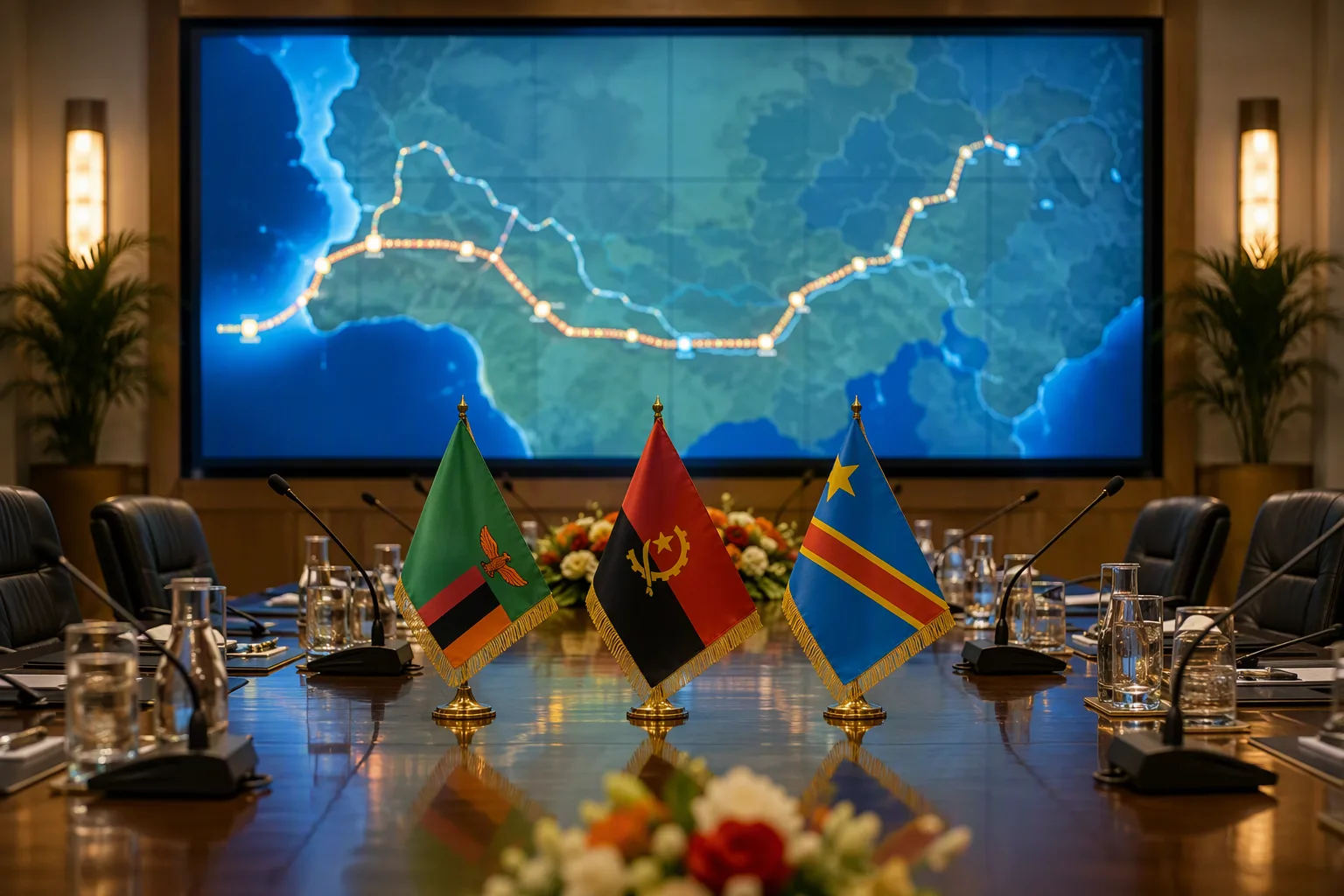
For two days from this morning, the geography of Zambian trade is being argued over at the InterContinental. President Hichilema is expected to open the Second Lobito Corridor Coordination Meeting, hosted by Zambia with the World Bank Group, with delegations from Angola and the Democratic Republic of Congo, development partners and private-sector stakeholders at the table. The World Bank is represented at the top of its operational house: Anna Bjerde, its Managing Director for Operations, is attending. The Ministry of Finance and National Planning says the purpose is to strengthen coordination among the three countries and to develop the corridor into "a functioning economic ecosystem" connecting infrastructure with production, investment, markets and regional value chains.
The corridor's spine is the railway that runs 1,300 kilometres from the Atlantic port of Lobito across Angola to the Congolese border, linking the mining regions of the DRC — and, in the plan that brings Zambia to the table, extending south. The Lobito Atlantic Railway concession is moving Congolese copper to the coast, with roughly 240,000 tonnes expected to travel from Kolwezi to Lobito this year. For Zambia, whose copper travels south to Durban or east to Dar es Salaam, a western route to the Atlantic is the strategic prize: shorter to Europe and the Americas, and a hedge against congestion on the legacy corridors.
The first coordination meeting, in Luanda in February, produced the diagnosis this one must treat: lack of coordination, Ms Bjerde said then, is one of the biggest risks to the project. Luanda's answer was a standing mechanism and a monitoring tool — a tracker for near-real-time visibility of what each country and partner is doing. The Bank's offer spans public and private financing and, pointedly, guarantees: the Multilateral Investment Guarantee Agency has already backed investment in the Lobito Atlantic Railway, the kind of risk cover meant to make the corridor "investable" for private capital rather than a perpetual hostage of public budgets.
The agenda reaches beyond rails: trade facilitation and border modernisation, energy access under the Mission 300 initiative, agriculture and agribusiness value chains through AgriConnect, and digital connectivity. What Zambia needs out of the room is specific: a financed path for the extension into its North-Western copper country, a border regime that does not tax the corridor's speed away, and a timetable. Conferences about corridors are easy; corridors are not. The test of this one is whether the tracker Ms Bjerde described in Luanda starts filling with Zambian entries.
Sources: Times of Zambia, "HH to grace Lobito Corridor indaba" (4 Oct 2026); Open Zambia, "Lusaka to host high-level Lobito Corridor talks" (2 Oct 2026); Ministry of Finance and National Planning statement (Oct 2026); Lusa/AMAN and RFI reporting on the inaugural Luanda coordination meeting and the World Bank's guarantee instruments (Feb 2026).
Back to the front page