
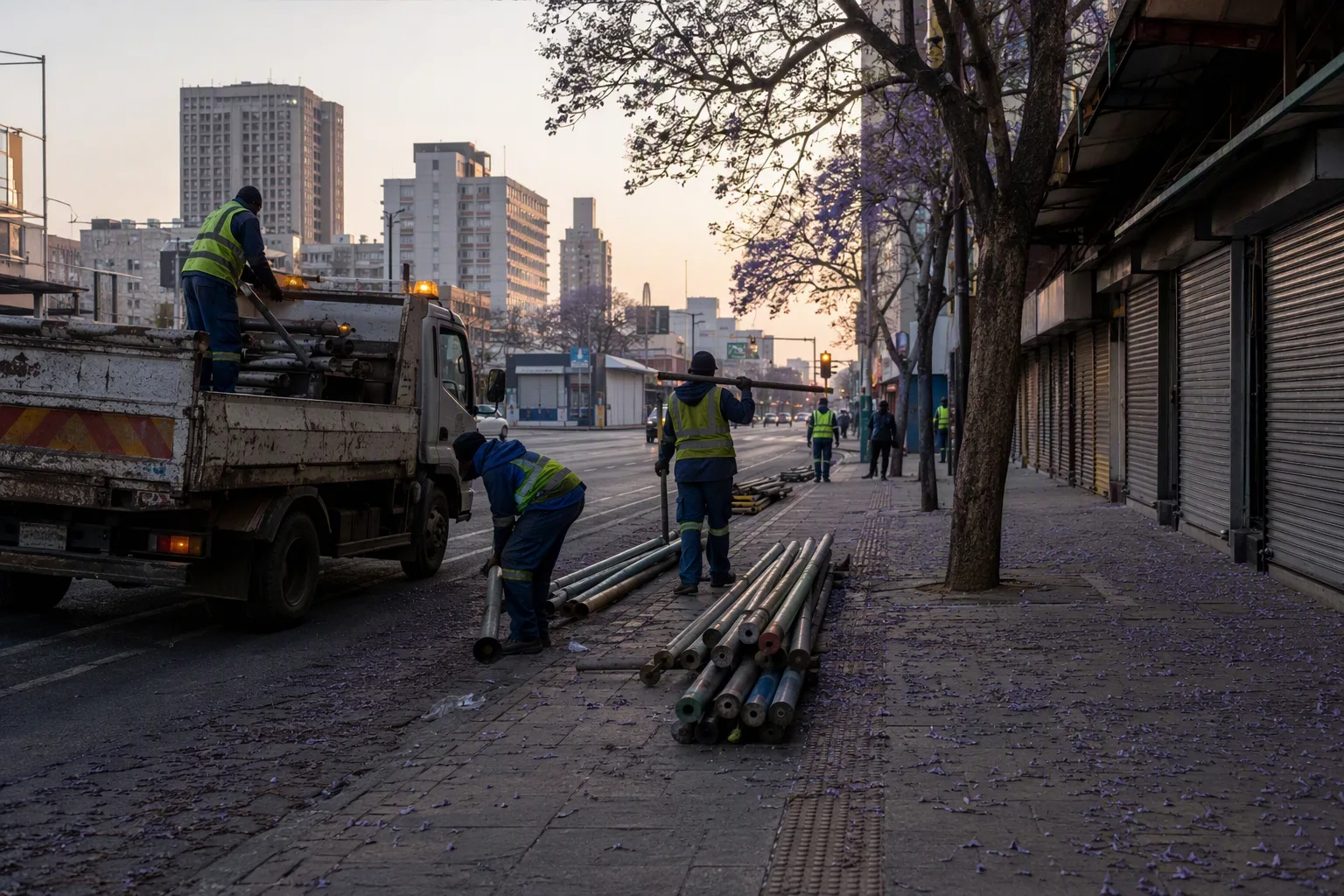
Lusaka's central business district is being rearranged this morning. Operation Clear Path, the joint enforcement exercise by Lusaka City Council and the Zambia Police Service, began on Saturday, removing street vendors and bus drivers from unauthorised trading areas across the CBD and other affected parts of the city. From today, the council says, street vending in those areas will not be permitted, and buses must load and offload at designated stations.
Mayor Chitambala Mwewa has framed the operation as housekeeping rather than punishment. "This operation is not intended to punish anyone but to restore order and promote sustainable trading practices," he told reporters, urging traders and bus operators to move into the designated markets and bus stations where, he said, the council has provided space. Police spokesperson Godfrey Chilabi said the exercise is planned to ensure legal compliance while protecting human rights and property — a formulation that will be tested on the pavements this weekend.
The public-health arithmetic behind the date is not hidden. Lusaka District has recorded 130 cases in the cholera outbreak declared by the Ministry of Health on Wednesday — 39 of them laboratory-confirmed — the largest district share of the 304 suspected cases and 11 deaths counted across seven districts in five provinces as of 29 September. Street vending, waste dumping and blocked drains are not the outbreak's cause, but they are its allies: the 2023–24 epidemic taught Lusaka what crowded, unserviced trading spaces do to a cholera curve, and the 2017 clearances were run on the same logic.
The traders are not persuaded, or not entirely. In videos circulating on social media this week, vendors facing eviction have pleaded with the administration to legalise street vending rather than clear it, arguing that the pavement is the only shopfront the capital's informal economy affords them. The council's answer is the designated market; the vendors' rejoinder is footfall. It is an argument Lusaka has had for a decade, and the tension between order and income never quite resolves — it only relocates.
What to watch: how the operation handles the Monday commute; whether the designated markets absorb the displaced traders; and whether the outbreak numbers — 35 patients in treatment nationally at the last count, 230 discharged — bend as the rains approach. The council says traders with questions about available spaces can approach it directly. The city, for one Saturday at least, looks tidier and feels poorer, and knows it.
Confirmed vs. contested
Confirmed: Operation Clear Path began on Saturday, 3 October, as a joint LCC–Zambia Police exercise; the mayor's and the police spokesperson's statements are on record; Lusaka District has 130 recorded cases within the declared national outbreak; relocation to designated markets and bus stations is the council's stated alternative.
Contested: Whether cleared vendors can in practice trade legally and profitably from designated spaces. The vendors' plea for legalisation remains unanswered.
Sources: Lusaka City Council statement and mayoral press address (2 Oct 2026); Zambian Economist, "Operation Clear Path: LCC and Police to Remove Street Vendors From Lusaka CBD From 3 October" (2 Oct 2026); ZNBC reporting on the vending directive (2 Oct 2026); Zambia Monitor, "Govt declares cholera outbreak in Zambia after 304 cases, 11 deaths" (30 Sep 2026); Lusaka Brief archive on the 2017 street clearances.
Back to the front page