
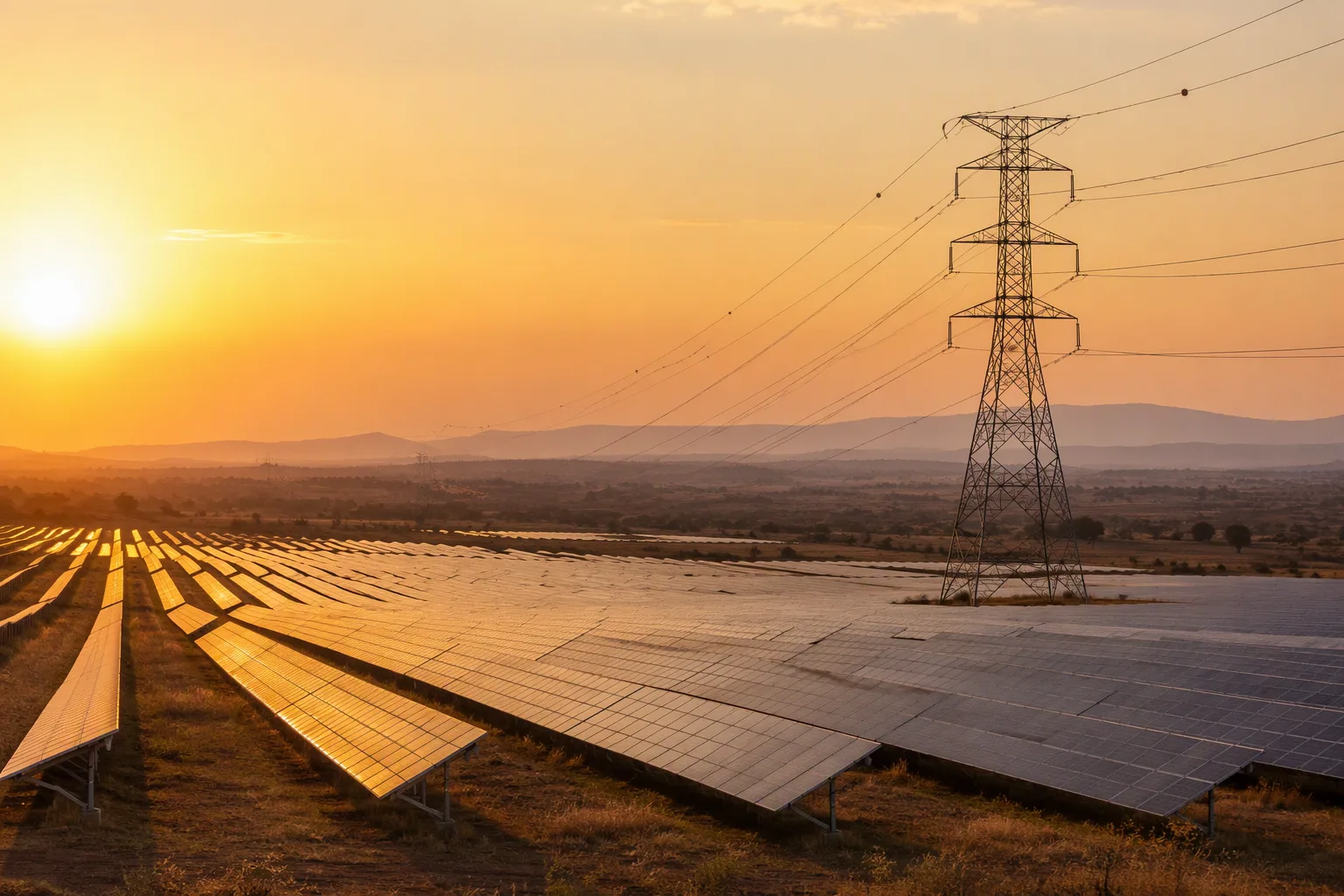
The megawatt count has crossed a line the drought years made urgent. Vice-President W.K. Mutale Nalumango told the Energy Forum for Africa conference in Lusaka — convened under the theme "Driving a Borderless Future for Africa" — that Zambia's installed generation capacity has risen from 3,777MW in 2024 to 4,722.3MW, and that solar capacity has surged from 178MW to 1,027.5MW, carrying the country past its 1,000MW-by-2026 solar target with months to spare.
The ministry's breakdown shows how the ground shifted: some 700MW of solar and 600MW of thermal have been actualised in the current build-out, energy officials said, much of it private-sector driven — independent producers who moved faster than the utility that once monopolised generation. It is the first credible evidence that the post-drought energy strategy is producing electrons rather than memoranda: after the 2024/25 El Niño drought exposed the danger of a grid that is four-fifths hydro, every new solar megawatt is a small insurance policy against the next failed rainy season — a season forecasters warn may arrive under another strong El Niño.
The forum was equally frank about where the wall now stands: transmission. Generation is arriving faster than the high-voltage lines needed to move it, officials conceded, calling the network the weak link in the chain — the reason a borderless African power market remains a theme rather than a trade. Behind the wires queue the mega-projects: Batoka Gorge's 2,400MW, where procurement preparedness is the current task; Devil's Gorge's 2,380MW on the Zambezi; and a 1,000MW floating solar scheme on Lake Kariba whose pre-feasibility work is complete. The headline target beneath them all is 10,000MW of installed capacity by 2031.
The economics are not abstract. The Treasury's own budget framework banks on copper output climbing toward 1.08 million tonnes in 2027, and every smelter and shaft in that ladder draws from the same grid the drought keeps testing. Mines are now signing their own solar purchase agreements precisely because they cannot wait for the wires. Zambia has proved it can build panels quickly; the 2031 question is whether it can string lines at the same speed — and whether the borderless market the forum dreamed about will be there to buy the surplus when it does.
Sources: ZNBC and Times of Zambia coverage of the Vice-President's address to the Energy Forum for Africa, Lusaka (7 Oct 2026); Ministry of Energy statements on installed capacity and the solar milestone (Oct 2026); Zambia Daily Mail on the transmission constraint and the Batoka, Devil's Gorge and Kariba floating solar pipeline (Oct 2026); Lusaka Brief archive on the drought-energy strategy and the 2031 target (2025–2026).
Back to the front page