
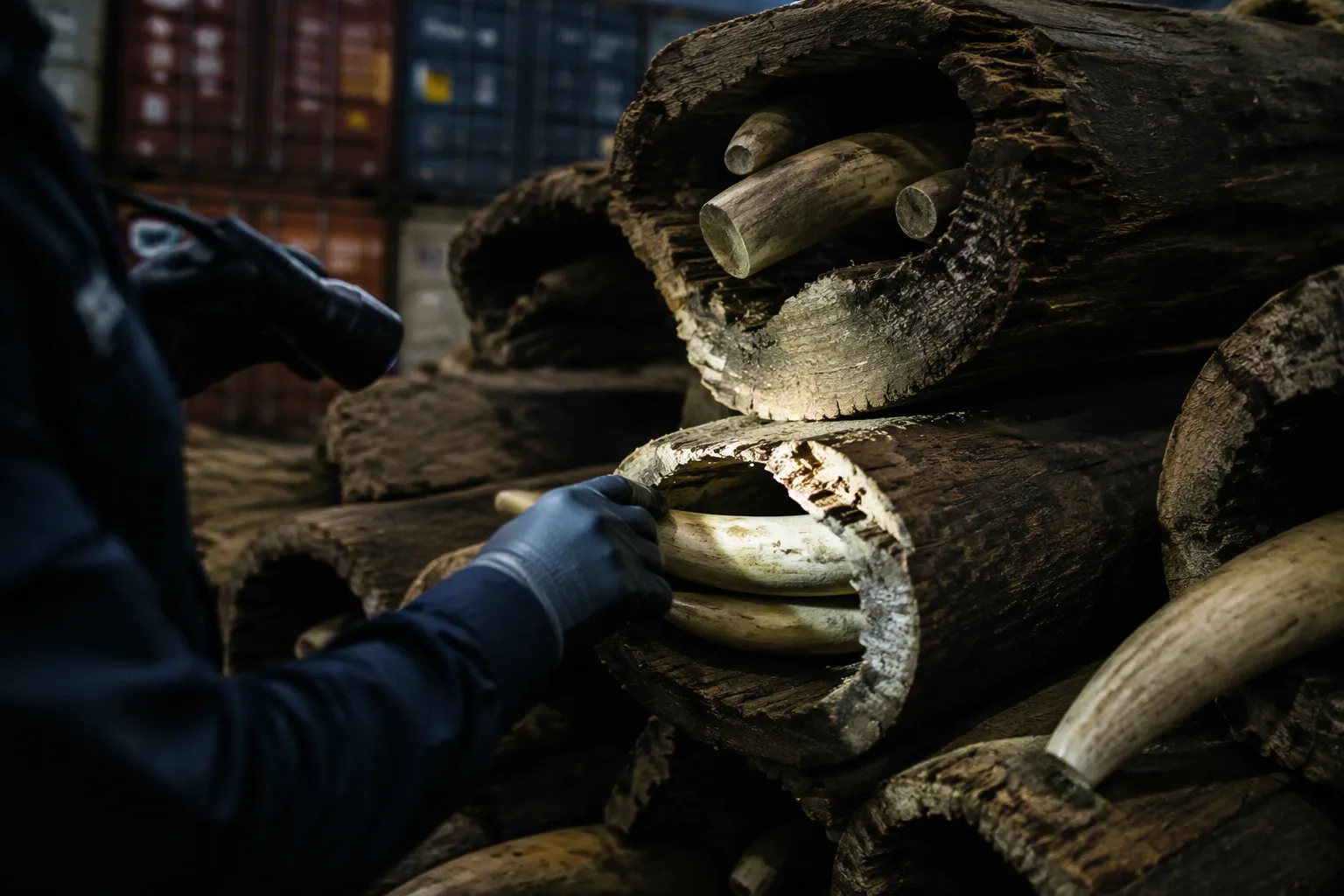
The tusks were hidden inside the wood itself. The Ministry of Tourism has confirmed that Zambia is working with Thai authorities to establish the origin of a consignment containing 446 elephant tusks — concealed, preliminary reports say, inside hollowed timber logs — seized by authorities in Thailand and a second country yet to be named, alongside 56,000 kilograms of timber. Permanent Secretary Evans Muhanga was careful with the central fact: preliminary information suggested the consignment may have originated from Zambia, but that reported origin "had not been established".
The investigation now runs along three tracks. The Department of National Parks and Wildlife, with the Department of Forestry, the Zambia Revenue Authority and other agencies, is reviewing the permits, authorisations and customs declarations attached to the shipment — to establish what cargo was declared, who the parties are, and whether any document was falsified or improperly obtained. A second track is forensic: tracing markings on the seized tusks and reconstructing container movements and transit routes, with Muhanga pointedly noting that Zambia's position as a land-linked country means it may have been a transit corridor rather than the source. The third track is internal: an inspection of the Government's own ivory strongroom, which he said has so far revealed no indication that stock was stolen or unlawfully removed, and a review of poaching data that does not currently indicate killings on the scale the seizure would imply.
The seizure lands in an uncomfortable pattern. In March, acting on intelligence from the Environmental Investigation Agency, Zambian officers seized just under 550 kilograms of ivory in Lusaka and arrested ten people, breaking what investigators described as a cross-border syndicate. Internationally, 2026 has produced a run of large hauls — 504 tusks in Tanzania, more than a tonne in Vietnam hidden the same way, in hollowed logs, and 1,756 kilograms in Laos — which analysts increasingly trace to the Kavango-Zambezi transfrontier region. If the Thai consignment is confirmed as Zambian in origin or transit, the questions Muhanga's investigators must answer become questions for the ports, the borders and the permit desks. No possibility, the ministry said, is being ruled out.
Confirmed vs. unestablished
Confirmed: The ministry's statement and the investigation it announces; the reported seizure figures (446 tusks; 56,000kg of timber); the concealment method as reported; the strongroom inspection's preliminary clean result; the involvement of DNPW, Forestry and ZRA.
Unestablished: Any Zambian origin or transit role for the ivory — expressly not yet established by the ministry itself; the identity of the second country and of the parties behind the consignment; whether any permit was falsified.
Sources: Times of Zambia, "Zambia works with Thai authorities to investigate reported ivory seizure" (8 Oct 2026); Ministry of Tourism statement by Permanent Secretary Evans Muhanga (7 Oct 2026); Environmental Investigation Agency on the March 2026 Lusaka seizure (Mar 2026); Patrol/Mongabay analysis of the 2026 ivory seizure pattern (Aug–Sep 2026).
Back to the front page