
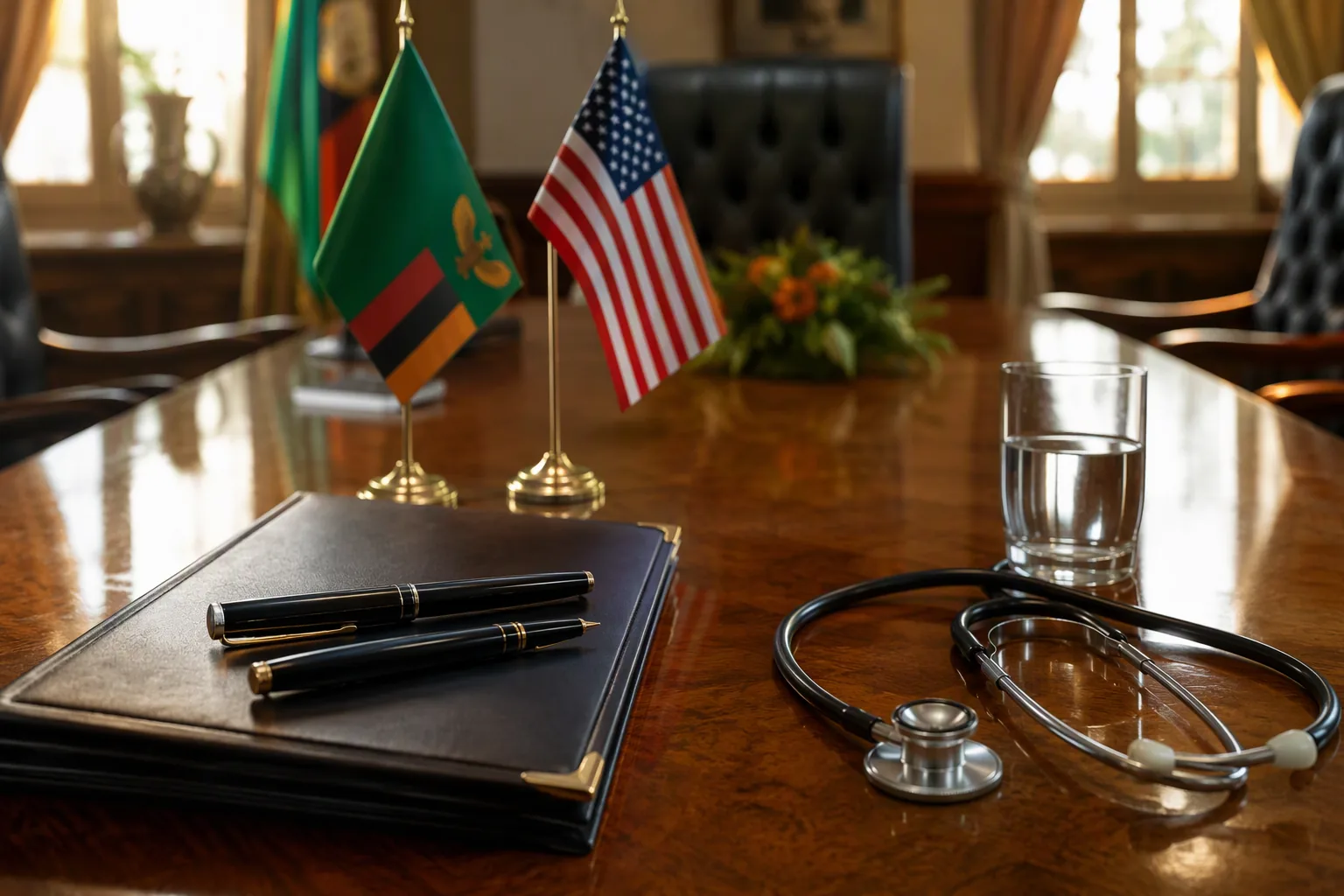
The deal that Washington once parked over copper and patient files is coming back to the table — without either condition attached, says the minister who will sign it. Health Minister Professor Roma Chilengi announced on Tuesday that Zambia will sign its five-year health cooperation agreement with the United States on Thursday, ending months of public doubt over a package worth US$1.5 billion in American funding. Zambia's own health expenditure over the same five years, he said, is projected at US$2.1 billion.
"The government is pleased to announce that it will sign the agreement … on Thursday," Professor Chilengi told a press conference in Lusaka. The revision, he said, had answered Zambia's two objections. Data-sharing will be limited to information required to monitor and evaluate US-funded health programmes, and a clause that would have obliged Zambia to hand over patient medical specimens on request has been removed. On the question that has hung over the talks since last year — whether the health money was a lever for mining access — his answer was flat: "there is no mention of critical minerals" in the pact, and he was not aware of any separate critical-minerals agreement being negotiated with Washington.
The road to Thursday was neither straight nor quiet. Negotiations stalled earlier this year over Lusaka's concerns about data privacy and a reported American attempt to tie the funding to access to critical minerals — terms Zambian officials called unacceptable in May. Last December, the signing was abruptly scrapped after a State Department official travelled to Lusaka and announced that economic cooperation, including in the mining sector, would precede the health money. The revised text, as described by the minister on Tuesday, represents a Zambian negotiating win on every point it contested — a claim that will be testable once the signed document is public.
The money itself is not abstract. The United States is the largest external funder of Zambia's HIV/AIDS, malaria and public-health programmes, and the five-year envelope anchors treatment pipelines that clinics from Kanyama to Kasama plan around. The agreement belongs to the Trump administration's post-USAID architecture of one-on-one health deals, under which poorer countries are meant to transition from aid to self-reliance: Kenya, Tanzania and Uganda have signed comparable pacts; Ghana and Zimbabwe walked away from theirs over the data-sharing demands. Zambia's version, if the minister's account holds, is the one that proved the terms were negotiable. Thursday's ceremony will say whether the signature was worth the wait — and the fine print, once published, will say what the wait was worth.
Confirmed vs. claimed
Confirmed: Professor Chilengi announced on Tuesday that the agreement will be signed on Thursday; the US$1.5 billion (US, five years) and US$2.1 billion (Zambia) figures; the removal of the specimen-sharing clause; the narrowing of data-sharing to programme monitoring and evaluation — all as stated at the minister's press conference.
Claimed or unverified: That the pact contains no minerals conditionality of any kind — the minister's account, which can only be fully checked against the signed text; the status of any separate US-Zambia minerals discussion, which the minister said he was unaware of.
Sources: Reuters, "Zambia to sign $1.5 billion US health pact after resolving differences over data-sharing" (6 Oct 2026); CNBC Africa, minister's press-conference remarks (6 Oct 2026); The Africa Report, "Zambia secures $1.5bn US health package after stripping out Trump's mineral demands" (6 Oct 2026); Zambia Daily Mail on the revised MOU (6 Oct 2026); EATG on the December 2025 postponement (11 Dec 2025); Lusaka Brief archive.
Back to the front page