
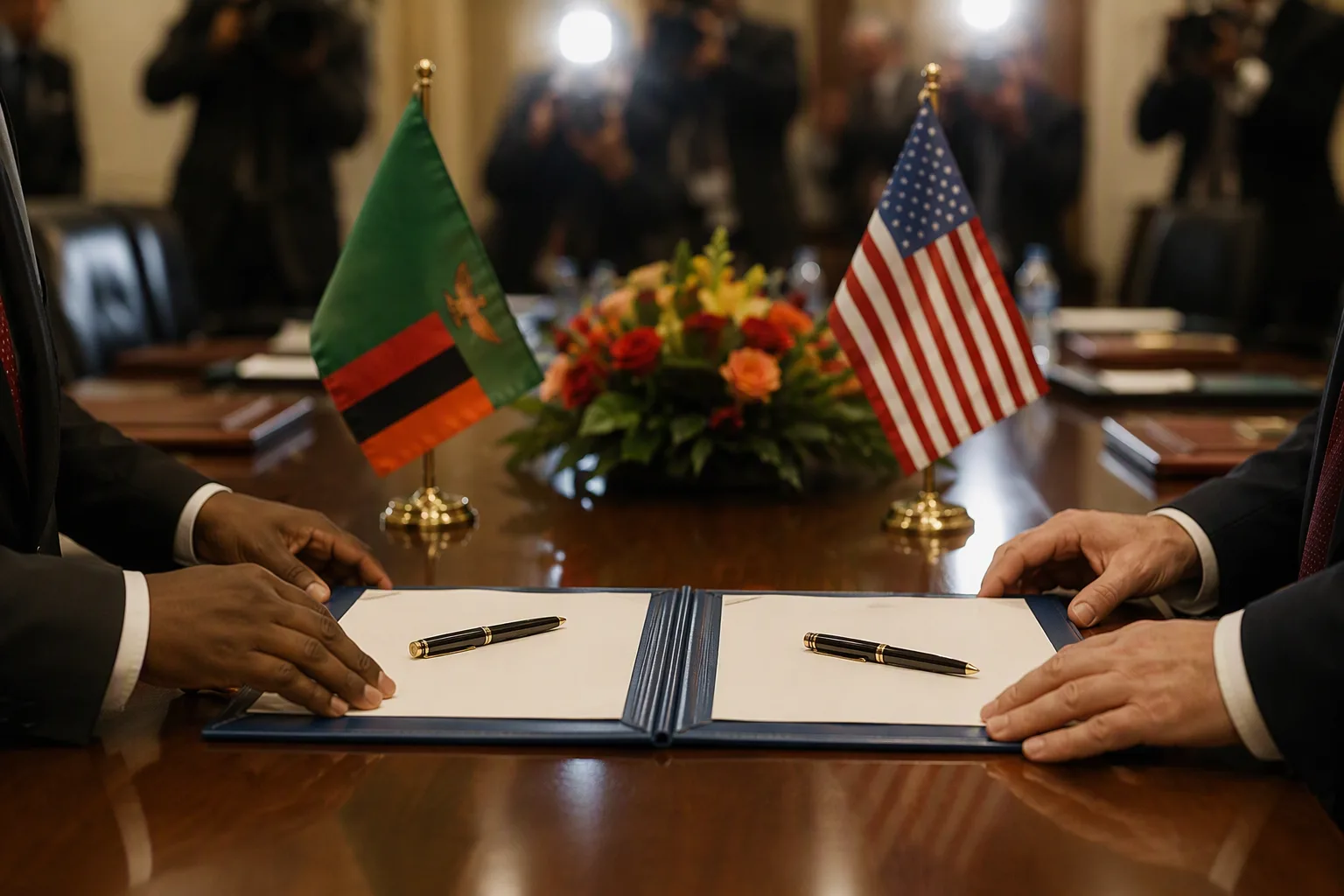
The pens come out today. Zambia and the United States are scheduled to sign their five-year health cooperation agreement at the Ministry of Finance in Lusaka this morning, closing a negotiation that collapsed twice over patient specimens and suspected mining conditionality — and opening an envelope worth a combined US$3.6 billion: US$1.5 billion in American funding over five years, against US$2.1 billion in Zambia's own projected health expenditure over the same period.
The text being signed is not the one Washington first proposed, Health Minister Professor Roma Chilengi told the country this week. The clause that would have obliged Zambia to hand over patient medical specimens on request has been removed; data-sharing is confined to information needed to monitor and evaluate US-funded health programmes; and on the question that shadowed the talks for a year, his answer was categorical: "there is no mention of critical minerals" in the agreement. Cabinet approved the signing on the advice of the Attorney General. The United States remains the largest external funder of Zambia's HIV/AIDS, malaria and public-health programmes, and the pact anchors treatment pipelines that clinics across the country plan around.
The sceptics have not packed up. Socialist Party leader Fred M'membe argues the deal "leaves Zambia chained to foreign aid" — that a country exporting copper, cobalt and emeralds should be closing tax loopholes and illicit financial flows to fund its own clinics rather than signing five-year dependency renewals. The DPP's Antonio Mwanza has demanded the revised text be published in full so the public can verify the minister's account for itself. That is now the operative test: Professor Chilengi's description of the document can only be checked against the document. The minister has the pen today; the public will want the paper.
Zambia's signature lands in a continental sorting. Roughly two dozen African governments have signed comparable bilateral health pacts under Washington's post-USAID architecture. Zimbabwe walked away from a US$367 million proposal it called lopsided — the United States ended all health assistance to Zimbabwe last month, and researchers cited by the Associated Press warn of more than 75,000 additional HIV infections there within a year if the funding vacuum holds. Ghana's government also rejected the data terms, and Namibia is phasing out rather than signing on. Lusaka's wager is different: negotiate the clauses, keep the money, and dare the critics to read the fine print. By press time, the ceremony had not begun; this story will be updated when the signatures are confirmed.
Confirmed vs. claimed
Confirmed: The signing is scheduled for today at the Ministry of Finance; the US$1.5 billion (US) and US$2.1 billion (Zambia, five years) figures; the removal of the specimen-sharing clause; the narrowing of data-sharing to programme monitoring and evaluation; Cabinet's approval — all as stated by the health minister and reported by Reuters and state media.
Claimed or unverified: That the pact contains no minerals conditionality of any kind — the minister's account, testable only against the signed text; M'membe's characterisation of the deal as continued dependency, which is argument, not fact; the status of any separate US-Zambia minerals discussion, which the minister said he was unaware of.
Sources: Reuters, "Zambia to sign $1.5 billion US health pact after resolving differences over data-sharing" (6 Oct 2026) and signing-day scheduling (7–8 Oct 2026); Fortune/AP on the continental health-pact programme and Zimbabwe's rejection (7 Oct 2026); Business Insider Africa on the Ministry of Finance ceremony (8 Oct 2026); Lusaka Times on M'membe's remarks (7 Oct 2026); Zambia Monitor, "DPP demands full disclosure of $1.5 billion health agreement with U.S." (5 Oct 2026); Open Zambia on Cabinet approval (Oct 2026).
Back to the front page