
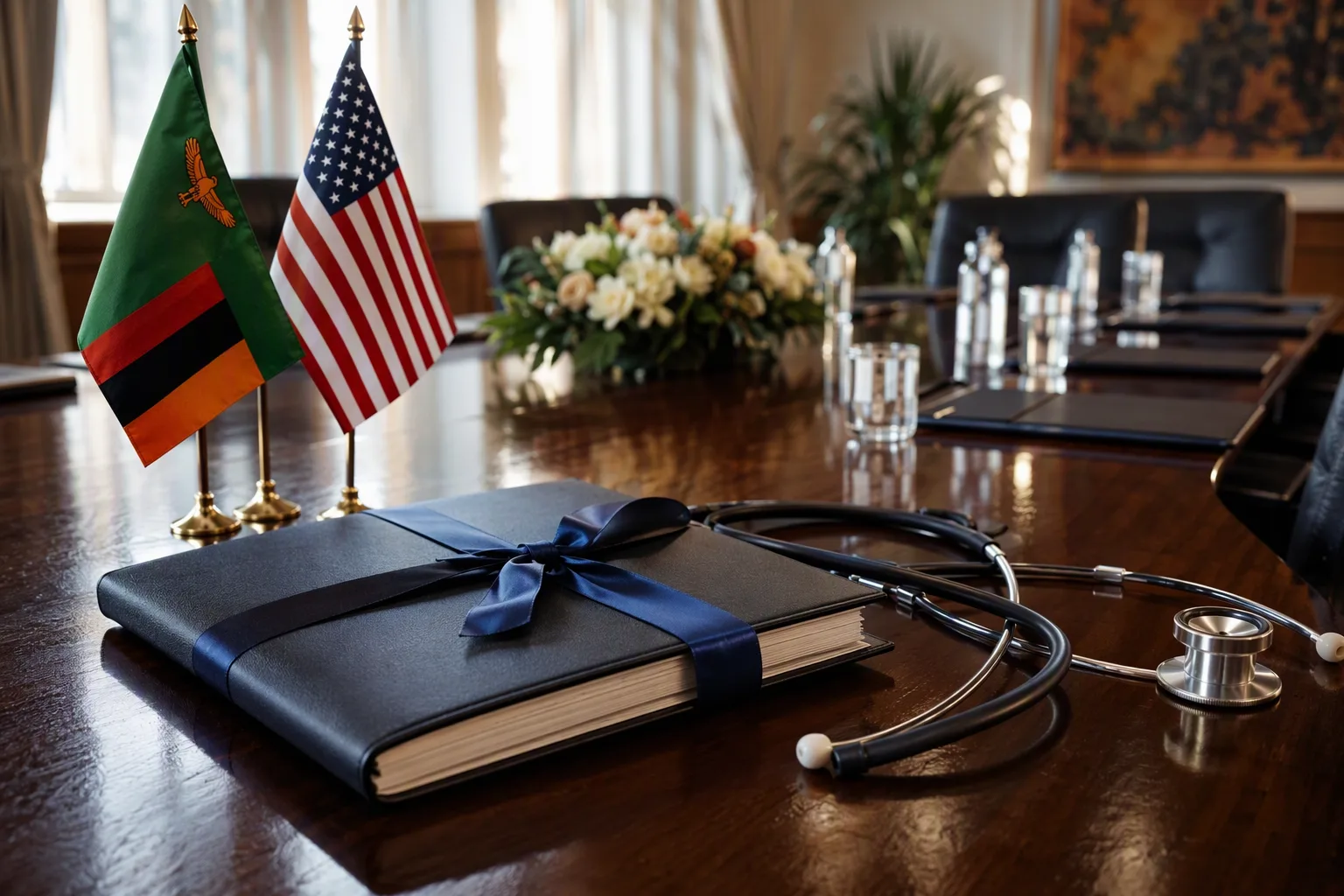
The signatures landed on schedule. Ministers of Foreign Affairs, Finance and Health joined US officials at the Ministry of Finance on Thursday to sign the five-year US–Zambia Health Sector Cooperation Agreement (2026–2030), closing a negotiation that twice threatened to collapse over specimen-sharing and patient-data clauses — both of which were removed from the final text. The ceremony confirms, and quietly corrects, the figures this newspaper carried on Thursday: the US State Department values the agreement at US$2.49 billion in total, with Washington contributing US$1.52 billion and Zambia investing US$975 million in its own health system over five years — a smaller envelope than the US$3.6 billion combined figure Zambian officials had put forward earlier in the week.
Health Minister Professor Roma Chilengi said the agreement will support the recruitment of 40,000 healthcare workers over its five years, and was categorical on the two anxieties that defined the public debate. "The Government will not be sharing any specimens with the United States because we removed all those aspects that raised concerns," he said. On the rumoured minerals conditionality: "As Ministry of Health, we never ever saw any MoU that speaks to minerals. There was no mention at all of any other MoU." The US Chargé d'Affaires in Lusaka, Mich Coker, framed the pact as shared security: "Infectious diseases know no borders. A strong Zambian health system serves as a first line of defense for both our nations."
The backdrop is transactional Washington. The pact is part of the Trump administration's America First Global Health Strategy, built after the dismantling of USAID, which commits African governments to gradually raise their own health spending while US assistance phases down. At least nine African nations have signed versions that include data and specimen-sharing terms; Zimbabwe, Ghana and Namibia have refused. Zambia's route — negotiate the clauses out, keep the money — is the one Chilengi spent the week defending. The context also includes a warning shot: in 2025 the United States withdrew US$50 million in annual health support over what it called systemic theft of donated medicines, and last week the Government fired all 150 workers at the Zambia Medicines and Medical Supplies Agency, the body at the centre of that scandal.
The sceptics have not been signed off. Socialist Party leader Fred M'membe said the renegotiation merely pads the chains of dependency and repeated his demand that the Ministry of Health publish the complete, unedited MOU — the same test the DPP's Antonio Mwanza set earlier in the week. That is now the only outstanding verification: the minister's description of the text can be checked only against the text. Today the Government has the photograph; the public still wants the paper.
Confirmed vs. claimed
Confirmed: The signing took place on Thursday at the Ministry of Finance; the State Department's US$2.49 billion valuation (US$1.52bn US / US$975m Zambia); the removal of the specimen-sharing and patient-data clauses; Chilengi's and Coker's remarks as quoted; the ZAMMSA dismissals and the 2025 US$50 million withdrawal — all per the Associated Press and ministry statements.
Claimed or unverified: The reason for the gap between the US$3.6 billion mooted by Zambian officials and the US$2.49 billion in the US count — unexplained by either side at press time; the assertion that no minerals linkage exists anywhere in the bilateral discussion, testable only against the published text, which had not been released.
Sources: Associated Press, "US, Zambia sign $2.49B health financing pact after removing data and specimen-sharing terms" (9 Oct 2026); Ministry of Health statements and the signing ceremony at the Ministry of Finance (8 Oct 2026); Open Zambia on the renegotiated terms (6 Oct 2026); NPR on the America First Global Health Strategy rollout (2 Oct 2026); Lusaka Times on M'membe's statement (8 Oct 2026).
Back to the front page